Most clinicians learn to auscultate early in training and then use a stethoscope every day. You might expect years of listening to make everyone an expert. Research says otherwise: across several large studies, students and doctors correctly identify only a minority of heart and lung sounds, and their skill stops improving after medical school. The good news is that the same body of research points to what does work. Numbers in brackets refer to the references at the end.

Auscultation practice on a training manikin. Image: Pöllö, CC BY 3.0, via Wikimedia Commons.
How accurate are we? What the studies found
Heart sounds
In a multicenter study of 453 internal medicine and family practice trainees and 88 medical students, Mangione and Nieman found that residents recognized only about 20% of cardiac events. Accuracy improved little with each year of residency, and residents did not score significantly better than medical students [1].
A larger study by Vukanovic-Criley and colleagues tested 860 participants, from medical students to faculty and private practitioners, with a 50-question multimedia cardiac examination test. Third- and fourth-year students scored higher than first- and second-year students, and cardiology fellows scored best. But students from the third year onward, residents and practicing physicians performed about the same: cardiac examination skills did not improve after the third year of medical school, and the authors suggested they may decline after years in practice [2][3].
Lung sounds
The picture is similar for the lungs. In a companion study, internal medicine and family practice trainees recognized less than half of all respiratory events, with little improvement per year of training and no significant advantage over medical students [4].
More recently, Hafke-Dys and colleagues asked 185 pulmonologists, pediatricians, other physicians, interns and medical students to classify 24 recorded respiratory sounds. Only about 41% of answers matched the expert reference fully or partially [5]. Some findings stand out:
- Wheezes were recognized most reliably.
- Rhonchi were the most ambiguous class and were often mistaken for wheezes or crackles.
- Different types of crackles were frequently confused with one another.
- Pulmonologists performed better overall, but the advantage was uneven between sound types.
- Grouping sounds into broader standard classes (as recommended by the ERS, ATS and ILSA) raised accuracy substantially, and the authors recommended training with expert-labeled sound databases [5].
Why doesn't experience fix it?
These studies suggest that simply seeing patients is not enough. On the wards, a given murmur or adventitious sound may come up rarely, often without immediate confirmation of what it was. Without a reliable label and without many repetitions, the ear has little chance to calibrate. Barrett and colleagues described cardiac auscultation as, in part, a technical skill, one that can be trained like any other [6].
What works: repetition and hands-on practice
Hundreds of repetitions
Barrett and colleagues had medical students listen to 500 repetitions of each of four basic cardiac murmurs. Average scores in the two training groups rose from about 13.5% to 85% and from about 21% to 86%, while a control group without the training changed little (about 24% to 32%) [6]. In other words, focused repeated listening took students from guessing to recognizing most murmurs correctly.
Simulation-based training
A systematic review and meta-analysis by McKinney and colleagues pooled studies of simulation-based training for cardiac auscultation. Compared with no intervention, training produced large improvements in knowledge (pooled effect size 1.10) and skills (0.87), although results varied widely between studies. Hands-on practice with the simulator stood out as an important design feature [7].
Putting the evidence into practice
- Listen many times, not once. The improvement in the repetition study came from hundreds of listens per sound [6]. Loop a sound until you can recognize it without thinking, then come back to it on later days.
- Always know the right answer. Practice with recordings that are reliably labeled, as Hafke-Dys and colleagues recommend [5], so you are not reinforcing a wrong guess.
- Focus on the sounds people confuse. Rhonchi versus wheeze and the different crackles were the main sources of error in the lung sound study [5]. Listen to them back to back.
- Use sight as well as hearing. The authors of the multicenter cardiac study recommended training that combines audio and visual examination [3]. Seeing where S1, S2 and a murmur fall in the cardiac cycle makes the timing easier to hear.
- Test yourself. Naming a sound without seeing its label is the only way to know what you actually recognize.
- Keep practicing after the exam. Skills plateau, and may decline, without deliberate practice [2][3].
Practice with Lung Heart Sounds
Lung Heart Sounds is an auscultation trainer with 23 heart sounds and 9 lung sounds, designed for exactly this kind of repeated, focused listening.
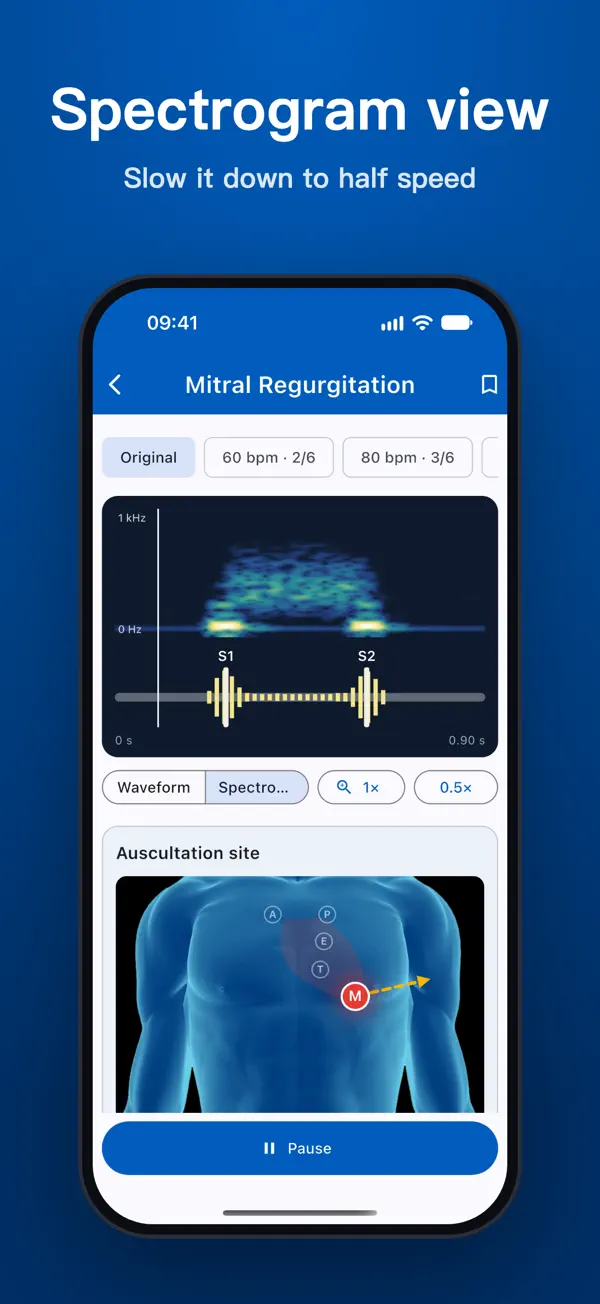
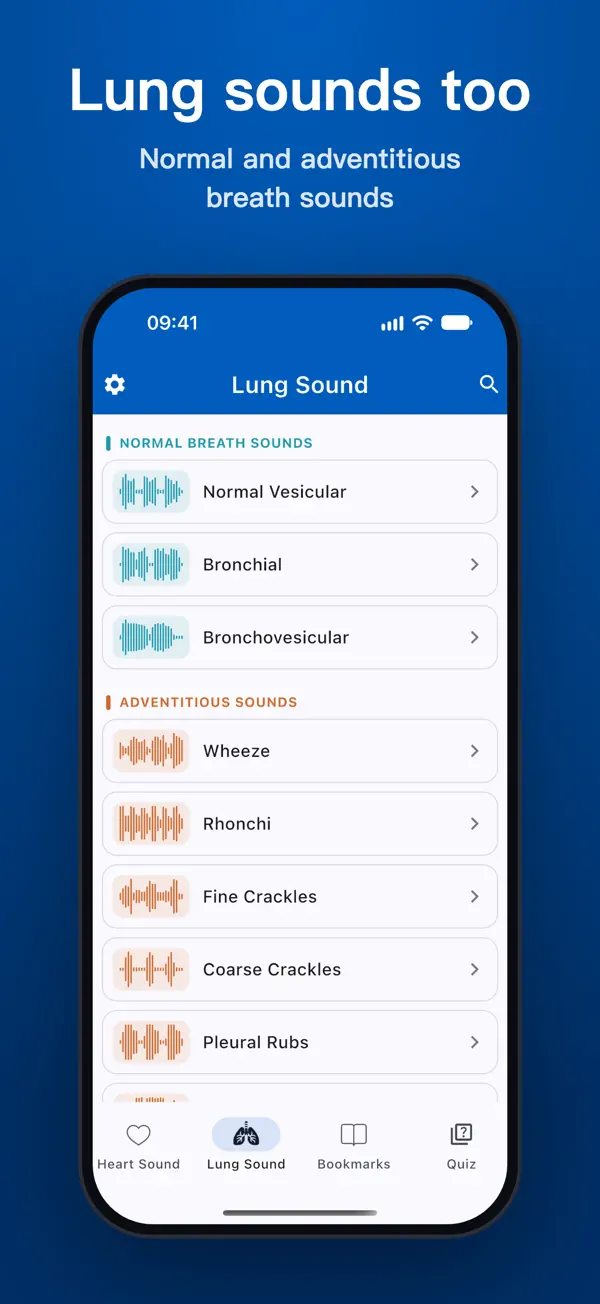
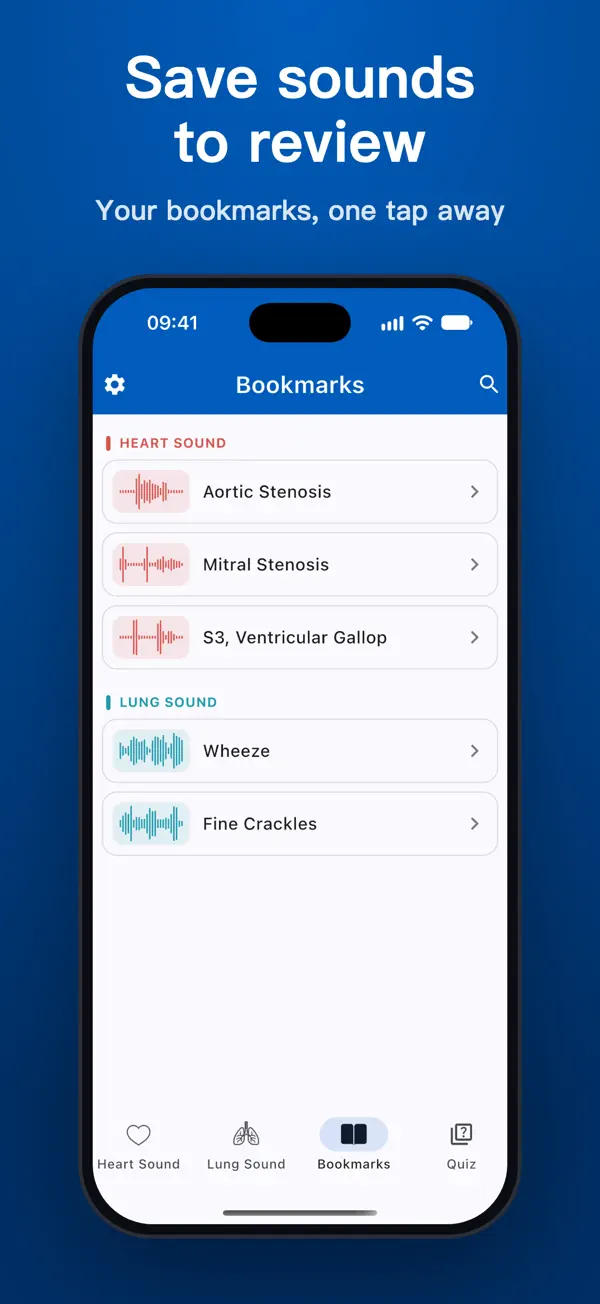
- Repeat as often as you need: every sound loops as long as you like, and you can slow it down to half speed (0.5×) to pick out splits, clicks and soft murmurs.
- See what you hear: a live phonocardiogram with S1 and S2 marked, plus a spectrogram view showing the pitch and timing of murmurs and added sounds.
- Know where to listen: a chest diagram highlights the aortic, pulmonic, Erb’s point, tricuspid and mitral areas, with arrows showing where each murmur radiates.
- Compare confusing sounds: wheeze, rhonchi, stridor, fine and coarse crackles and pleural rub, alongside vesicular, bronchovesicular and bronchial breath sounds.
- Test yourself: quiz rounds of 10 questions mix heart and lung sounds and use different recordings each time. Bookmark the sounds you miss to build your own review list.
- Works offline, with no account and no ads. Headphones are recommended, because low-pitched sounds such as S3, S4 and mitral stenosis are hard to hear on phone speakers.
Download on iOS: Lung Heart Sounds on the App Store
Download on Android: Lung Heart Sounds on Google Play
New to auscultation? Start with our practical guide to heart and lung auscultation.
Disclaimer: this article is for educational purposes only and is not a substitute for formal clinical training or professional medical advice. The studies cited did not evaluate Lung Heart Sounds. The app is not a medical device and must not be used to diagnose or treat any condition.
References
- Mangione S, Nieman LZ. Cardiac auscultatory skills of internal medicine and family practice trainees: a comparison of diagnostic proficiency. JAMA. 1997;278(9):717–722. PMID 9286830
- Vukanovic-Criley JM, Criley S, Warde CM, et al. Competency in cardiac examination skills in medical students, trainees, physicians, and faculty: a multicenter study. Arch Intern Med. 2006;166(6):610–616. doi:10.1001/archinte.166.6.610. https://doi.org/10.1001/archinte.166.6.610
- American Medical Association. Cardiac exam skills appear similar among med students, resident physicians [press release on Arch Intern Med. 2006;166]. EurekAlert!; 2006. https://www.eurekalert.org/news-releases/622722
- Mangione S, Nieman LZ. Pulmonary auscultatory skills during training in internal medicine and family practice. Am J Respir Crit Care Med. 1999;159(4):1119–1124. PMID 10194155
- Hafke-Dys H, Bręborowicz A, Kleka P, Kociński J, Biniakowski A. The accuracy of lung auscultation in the practice of physicians and medical students. PLoS One. 2019;14(8):e0220606. doi:10.1371/journal.pone.0220606. https://pmc.ncbi.nlm.nih.gov/articles/PMC6690530/
- Barrett MJ, Lacey CS, Sekara AE, Linden EA, Gracely EJ. Mastering cardiac murmurs: the power of repetition. Chest. 2004;126(2):470–475. PMID 15302733
- McKinney J, Cook DA, Wood D, Hatala R. Simulation-based training for cardiac auscultation skills: systematic review and meta-analysis. J Gen Intern Med. 2013;28(2):283–291. https://pmc.ncbi.nlm.nih.gov/articles/PMC3614132/