The ECG is one of the most common tests in medicine, and most students, nurses and doctors are expected to read one. But how well do we actually read them, and what kind of training makes a difference? This article looks at the research on ECG interpretation accuracy from medical school to cardiology, what nurses’ competency studies show, which teaching methods have been tested, why mixing and testing matter in practice, and how a computer’s reading can help or mislead. Numbers in brackets refer to the references at the end.

Photo: Niklas Jeromin, via Pexels.
How accurately do students, nurses and physicians read ECGs?
Students and physicians
A systematic review and meta-analysis in JAMA Internal Medicine (2020) gathered 78 studies that tested the accuracy of physicians’ or medical students’ ECG interpretations in a test setting [1].
- Across all training levels, the median accuracy was 54% on pretraining assessments and 67% on posttraining assessments [1].
- Pooled accuracy on pretraining assessments was 42.0% for medical students, 55.8% for residents, 68.5% for practicing physicians and 74.9% for cardiologists [1].
- Accuracy varied widely across studies [1].
The authors concluded that physicians at all training levels had deficiencies in ECG interpretation, even after educational interventions, and that improved education across the practice continuum appears warranted. They noted that the wide variation could reflect real differences in training or skill, or differences in how the tests were designed [1].
Nurses
Nurses often see the monitor or the 12-lead ECG first. A systematic review in the Journal of Advanced Nursing (2022) included 43 papers on nurses’ competency in ECG interpretation in acute care settings [2].
- Most studies measured knowledge rather than skills or attitudes [2].
- Nurses’ competency varied from low to high, partly because the studies used a range of different assessment tools [2].
- Nurses identified a lack of regular training and insufficient exposure in ECG interpretation, and reported a lack of knowledge and confidence [2].
A newer systematic review in Nurse Education in Practice (2026) found 23 studies of educational interventions for registered nurses. Education was associated with better ECG competence, and interventions with active learner engagement, structured practice and reinforcement appeared more likely to help. Evidence of learning attenuation over time was reported, and the authors suggested that spaced learning and reinforcement may better support lasting competence [3].
What this means: accuracy rises with training and experience, but even cardiologists did not reach perfect scores on these tests, and gaps remained even after training. Nurses face the same problem: training helps, but skills fade without regular exposure and practice. ECG reading is a skill to keep working on, not a box to tick once.
Which teaching methods have been tested?
A second systematic review and meta-analysis, published in Academic Medicine (2022) by the same research group, included 59 studies of ECG interpretation training enrolling 17,251 participants: medical students, residents or practicing physicians. Effects are given as standardized mean differences (SMD), where positive values favor the first method [4].
- Computer-assisted versus face-to-face teaching (8 studies): pooled SMD 0.23 (95% CI, 0.09 to 0.36), a small but statistically significant difference favoring computer-assisted instruction [4].
- Individual versus group training (5 studies): pooled SMD -0.35, favoring group study [4].
- Peer-led versus faculty-led teaching (4 studies): pooled SMD 0.38 (95% CI, 0.01 to 0.74), favoring peer instruction [4].
- Contrasting ECG features across diagnostic categories (for example QRS width) versus examining features within a single ECG or diagnosis (4 studies): pooled SMD 0.23 (95% CI, -0.30 to 0.76), not statistically significant [4].
- More systematic interpretation approaches (8 studies): pooled SMD 0.92 (95% CI, 0.48 to 1.37), a large, statistically significant effect [4].
The authors concluded that some instructional interventions appear to improve learning, but that many evidence-based instructional strategies have not been studied enough [4].
What this means: the largest effect came not from the teaching format but from reading every ECG in a systematic way. Computer-assisted learning had a small advantage over face-to-face teaching.
Does it help to mix different ECGs during practice?
In an older randomized study in Advances in Health Sciences Education (2003), medical students received the same instruction and then practiced in one of two ways: “contrastive” practice, where examples from different diagnostic categories were mixed together, or “non-contrastive” practice, where all examples of one category were practiced in a single block [5].
- Students who practiced with mixed examples were more accurate on new ECGs: 46% versus 30% (p < 0.05) [5].
- In a first experiment in the same paper, organizing teaching around features (such as QRS voltage) instead of diagnostic categories (such as bundle branch blocks) made no significant difference [5].
The authors concluded that the design and organization of deliberate practice can result in significant learning gain [5].
What this means: when you only practice one diagnosis at a time, you know the answer before you look. Mixing ECGs forces you to tell them apart. Keep in mind that when the 2022 meta-analysis pooled 4 studies of contrasting features, the effect was not statistically significant [4], so the evidence is promising but not settled.
Testing yourself and keeping the skill
In a partially randomized trial in the Journal of Electrocardiology (2016), 493 fourth-year medical students learned ECG interpretation by self-directed learning, lectures or small-group peer teaching. Within each format, the end-of-course exam counted towards the grade (summative) in one group and did not (formative) in the other. A retention test was given two months later [6].
- Retention test scores were predicted by summative assessments (adjusted beta 4.08; 95% CI 1.39 to 6.78) but not by the type of teaching [6].
- Overall performance levels and motivation did not predict performance decrease or skills retention [6].
The authors concluded that summative assessments increase medium-term retention of ECG interpretation skills, irrespective of instructional format [6].
What this means: in this trial, how students were tested mattered more than how they were taught. Being tested gives a reason to practice and shows what you do not yet know.
The computer reading: helpful, but it can lead you astray
Most ECG machines print an automated interpretation at the top of the tracing. In a randomized crossover trial in the Journal of the American Medical Informatics Association (2003), internal medicine residents read ECGs with and without the computer interpretation, and their answers were compared with cardiologist-determined findings [7].
- Without the computer interpretation, residents interpreted 48.9% of findings correctly; with it, 55.4% (p < 0.0001) [7].
- For findings where the computer advice was correct, accuracy was 53.1% without the advice and 68.1% with it [7].
- For findings where the computer advice was incorrect, accuracy was 56.7% without the advice and 48.3% with it; this drop was not statistically significant (p = 0.131) [7].
- Residents agreed with an incorrect computer interpretation 67.7% of the time when it was shown with the ECG, versus 34.6% when it was not [7].
A later study in the International Journal of Medical Informatics (2017) asked 15 junior cardiology fellows and 15 non-cardiology fellows to read 100 12-lead ECGs without a proposal, with a single proposal (half of them intentionally incorrect) and with four proposals of which one was correct [8].
- Diagnostic proposals increased overall accuracy, but accuracy was substantially reduced when the single proposal was incorrect [8].
- An interpreter was most likely to be correct when the ECG came with a correct proposal (OR = 10.87) or with multiple proposals (OR = 4.43) [8].
- Readers’ confidence correlated poorly with their scores [8].
A review in the Journal of the American College of Cardiology (2017) noted that limitations in the accuracy of computer interpretation persist despite improving algorithms, that inexperienced physicians may accept the automated diagnosis without criticism, and that over-reading by an experienced ECG reader is essential [9].
What this means: the computer’s statement is a second opinion, not the answer. A correct one helps, but a wrong one pulls readers along, and feeling confident is not proof of being right.
Lessons for learning ECG
- Expect gaps, at every level. Accuracy was far from perfect for students, residents, practicing physicians and even cardiologists, and gaps remained after training [1].
- Use the same systematic approach on every ECG. More systematic interpretation approaches had the largest effect of all teaching strategies studied [4].
- Mix different diagnoses when you practice. Practicing with mixed examples beat practicing one category at a time in a randomized study, although pooled evidence is still uncertain [4][5].
- Test yourself and check your answer. Graded testing predicted better retention two months later, regardless of how students were taught [6], and confidence alone was a poor guide to accuracy [8].
- Come back to it regularly. Nurses reported too little regular training and exposure, learning faded over time, and spaced, reinforced learning was suggested to keep the skill [2][3].
- Read the tracing before you read the computer statement. An incorrect computer interpretation led residents and fellows into the same mistake [7][8][9].
Practice with ECG Bootcamp
ECG Bootcamp is an ECG (EKG) interpretation trainer for medical and nursing students, nurses, residents, paramedics and other healthcare professionals. It teaches one idea at a time and then lets you practice on real 12-lead ECGs, with feedback after every answer.
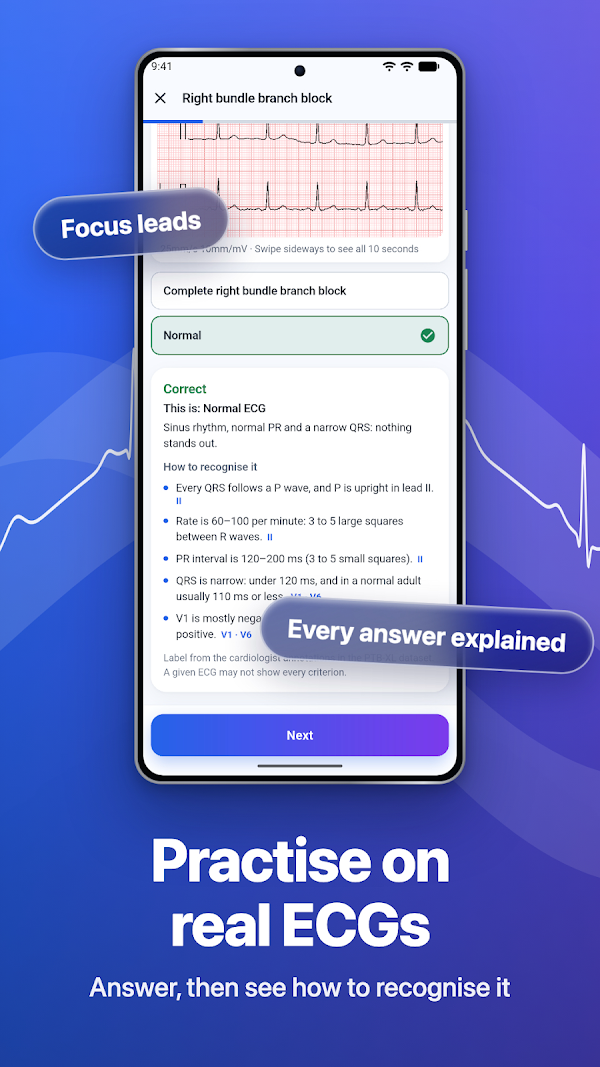
- 20 short lessons in 8 stages: each lesson explains one concept on a few cards, then lets you try it on real ECGs. Lessons show only the leads that matter for the concept, so you know where to look.
- Feedback in plain words: after each answer you see how to recognize the finding.
- Topics: heart rate, sinus rhythm and atrial fibrillation, bundle branch blocks, the PR interval and WPW, left ventricular hypertrophy, ST-T changes and prior infarction.
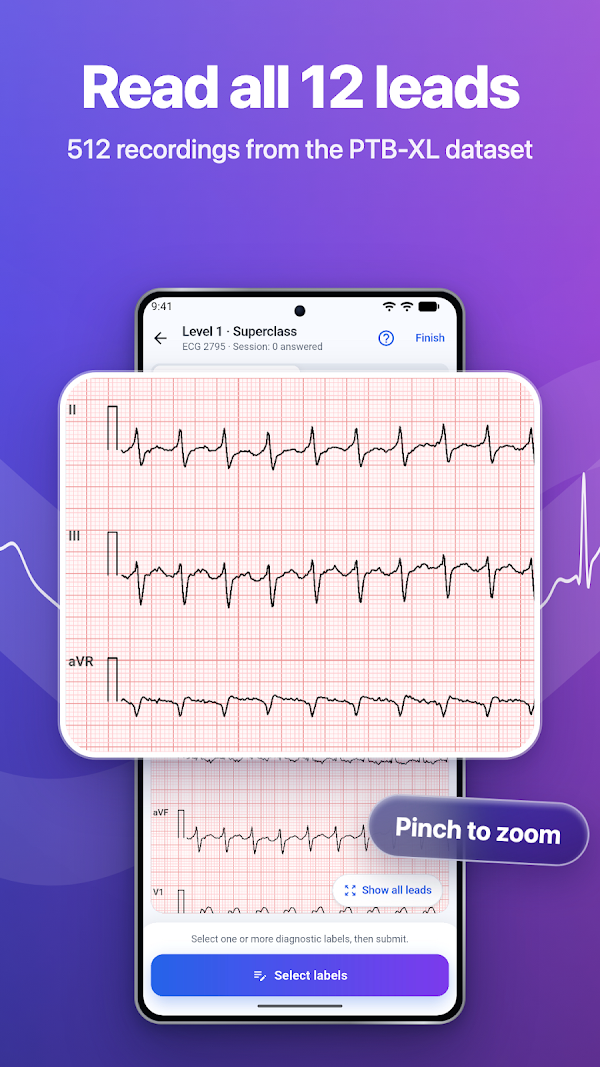
- Practice on 512 real ECGs: recordings from the PTB-XL research dataset, labeled by cardiologists, at three levels (5 classes, 23 subclasses, 44 ECG statements). One ECG can have several labels, so you choose all that apply, then compare your answer with the reference labels and read a short explanation of each one.
- Read it like the real thing: see all 12 leads together or go lead by lead, and pinch to zoom.
- Theory library: 39 articles with figures that you can read offline.
- Free and Pro: free to download, with the first 3 stages (10 lessons), the first practice level with 2 sessions a day and most of the theory library. Pro is a one-time purchase, not a subscription, and opens everything. Works offline, with no account and no ads, in English and Vietnamese.
Download on Android: ECG Bootcamp on Google Play
The iPhone version is in App Store review.
ECGs in the app come from PTB-XL v1.0.3 (Wagner et al., PhysioNet). Parts of the theory library are adapted from An EKG Interpretation Primer (Christianson and the Nurses International Team, 2019). Both are used under the CC BY 4.0 license.
Read more: Atrial Fibrillation at the Bedside: the Pulse, Counting the Heart Rate and AI Stethoscopes · Lung Heart Sounds, our auscultation trainer
Disclaimer: this article is for educational purposes only and is not a substitute for formal clinical training or professional medical advice. The studies cited did not evaluate ECG Bootcamp. ECG Bootcamp is not a medical device and must not be used for clinical decisions.
References
- Cook DA, Oh SY, Pusic MV. Accuracy of physicians’ electrocardiogram interpretations: a systematic review and meta-analysis. JAMA Intern Med. 2020;180(11):1461–1471. doi:10.1001/jamainternmed.2020.3989. https://pmc.ncbi.nlm.nih.gov/articles/PMC7522782/
- Chen Y, Kunst E, Nasrawi D, Massey D, Johnston ANB, Keller K, et al. Nurses’ competency in electrocardiogram interpretation in acute care settings: a systematic review. J Adv Nurs. 2022;78(5):1245–1266. doi:10.1111/jan.15147. PMID 34989423
- Boyd E, Lynch M, Coates V, Vanharen Y, Chamos AJ. Educational interventions to improve electrocardiogram interpretation competence among nurses: a systematic review. Nurse Educ Pract. 2026;94:104856. doi:10.1016/j.nepr.2026.104856. PMID 42142480
- Oh SY, Cook DA, Van Gerven PWM, Nicholson J, Fairbrother H, Smeenk FWJM, et al. Physician training for electrocardiogram interpretation: a systematic review and meta-analysis. Acad Med. 2022;97(4):593–602. doi:10.1097/ACM.0000000000004607. PMID 35086115
- Hatala RM, Brooks LR, Norman GR. Practice makes perfect: the critical role of mixed practice in the acquisition of ECG interpretation skills. Adv Health Sci Educ Theory Pract. 2003;8(1):17–26. doi:10.1023/a:1022687404380. PMID 12652166
- Raupach T, Harendza S, Anders S, Schuelper N, Brown J, Brown J. How can we improve teaching of ECG interpretation skills? Findings from a prospective randomised trial. J Electrocardiol. 2016;49(1):7–12. doi:10.1016/j.jelectrocard.2015.10.004. PMID 26615874
- Tsai TL, Fridsma DB, Gatti G. Computer decision support as a source of interpretation error: the case of electrocardiograms. J Am Med Inform Assoc. 2003;10(5):478–483. doi:10.1197/jamia.M1279. https://pmc.ncbi.nlm.nih.gov/articles/PMC212785/
- Novotny T, Bond R, Andrsova I, Koc L, Sisakova M, Finlay D, et al. The role of computerized diagnostic proposals in the interpretation of the 12-lead electrocardiogram by cardiology and non-cardiology fellows. Int J Med Inform. 2017;101:85–92. doi:10.1016/j.ijmedinf.2017.02.007. PMID 28347451
- Schläpfer J, Wellens HJ. Computer-interpreted electrocardiograms: benefits and limitations. J Am Coll Cardiol. 2017;70(9):1183–1192. doi:10.1016/j.jacc.2017.07.723. PMID 28838369