Crackles, wheezes and rhonchi are among the first words students learn on the respiratory ward, and among the most argued about. Is that sound a coarse crackle or a rhonchus? Does it matter? Research on lung sounds gives some useful answers: which terms clinicians actually agree on, which findings carry real diagnostic weight, and where the stethoscope reaches its limits. Numbers in brackets refer to the references at the end.

Image: Stethoscopes, CC BY-SA 3.0, via Wikimedia Commons.
The terms in brief
| Term | Type of sound | Notes |
|---|---|---|
| Crackles (fine or coarse) | Discontinuous | The recommended English term, divided into fine and coarse crackles [1] |
| Wheezes | Continuous, high-pitched | Defined by the American Thoracic Society committee as having a dominant frequency of 400 Hz or more [2] |
| Rhonchi | Continuous, low-pitched | Dominant frequency of about 200 Hz or less [2]; the term is used interchangeably with “low-pitched wheezes” [1] |
Wheezes are not specific to asthma: continuous adventitious sounds can be produced in many circumstances and heard in several diseases [2].
How well do clinicians agree?
Because a lung sound is described by the person who hears it, agreement between observers matters. The European Respiratory Society (ERS) set up a task force to build a reference collection of audiovisual lung sound recordings and to standardise terminology. It also surveyed the terms used to describe lung sounds in 29 languages across 33 European countries [3].
Using 20 of these reference recordings (10 children, 10 adults), Melbye and colleagues asked 12 physicians, 6 paediatricians and 6 doctors who examine adults, to classify each case into 10 detailed categories [1]:
- For the detailed descriptions (fine vs coarse crackles, high- vs low-pitched wheezes, rhonchi, each by respiratory phase), agreement was mostly slight to fair (κ<0.40). Only one category, high-pitched inspiratory wheezes, reached moderate agreement (κ=0.43).
- When sounds were grouped into broader categories, agreement improved to moderate or good: κ=0.62 for crackles and κ=0.59 for wheezes. Pleural rub reached κ=0.52.
- Agreement on rhonchi was particularly poor, in line with earlier studies.
- The paediatricians did not agree better than the other doctors on the recordings from children.
A second study by Aviles-Solis and colleagues had 28 observers from seven countries classify 120 recordings, displayed with their spectrograms, from 20 adults. Kappa values for crackles ranged from 0.20 to 0.58 between groups of observers, and for wheezes from 0.09 to 0.97. The authors concluded that standardising terminology across countries would improve communication about lung auscultation findings [4].
What this means: when you hand over a patient or write a note, broad terms such as “inspiratory crackles” or “expiratory wheezes” are understood more reliably than finer labels. Melbye and colleagues did not suggest discarding the finer terms, though: the distinction between fine and coarse crackles can matter for some diagnoses, for example early interstitial lung fibrosis [1].
Fine “Velcro” crackles and pulmonary fibrosis
Fine inspiratory crackles that sound like Velcro being pulled apart are one of the best-studied lung sounds. In an editorial, Cottin and Cordier asked whether these “Velcro crackles” could be the key to the early diagnosis of idiopathic pulmonary fibrosis (IPF) [5]. Two prospective studies have since looked at the question:
- Sellarés and colleagues auscultated 132 consecutive patients in an interstitial lung disease (ILD) diagnostic program. 83 patients (63%) had Velcro crackles. All patients with a usual interstitial pneumonia (UIP) pattern on high-resolution CT, and all patients with a final diagnosis of IPF, had Velcro crackles, and Velcro crackles were independently associated with the UIP pattern [6].
- Moran-Mendoza and colleagues assessed 290 patients referred to an ILD clinic in Canada. At the first visit, 93% of patients with IPF and 73% of patients with other ILDs had fine crackles. In IPF, fine crackles were more common than cough (86%), dyspnoea (80%) or a low diffusing capacity (87%). Observers agreed on fine crackles at a later visit in 90% of cases, and identifying them was not affected by lung function, symptoms, emphysema, COPD, obesity or the clinician’s experience. The authors concluded that fine crackles are a sensitive and robust screening tool that can lead to earlier diagnosis of IPF [7].
Acoustic analysis supports the idea that crackles differ between diseases. Piirilä and colleagues compared crackles in patients with fibrosing alveolitis, bronchiectasis, COPD and heart failure and found differences in frequency, waveform and timing. For example, inspiratory crackling ended significantly earlier in COPD than in the other groups [8].
Crackles in pneumonia and heart failure: useful, but not decisive
Crackles also feature in the work-up of pneumonia and heart failure, but here the research urges caution:
- Pneumonia. A review in JAMA’s Rational Clinical Examination series found that no individual clinical finding, or combination of findings, can rule in pneumonia. However, normal vital signs and a normal chest auscultation substantially reduce its likelihood [9].
- In 2810 European primary care patients with acute cough, 140 (5%) had pneumonia on chest radiography. GPs’ clinical judgment after history and examination had a sensitivity of 29%, a specificity of 99% and a negative predictive value of 96%: most radiographic pneumonias were not suspected clinically [10].
- Heart failure. In a JAMA review of patients with dyspnoea in the emergency department, the absence of rales (crackles) lowered the probability of heart failure (negative likelihood ratio 0.51). Interestingly, the physical sign that most increased the probability of heart failure was a heart sound, the S3 gallop (positive likelihood ratio 11) [11].
Wheezes and the severity of obstruction
Shim and Williams examined 93 patients with asthma on 320 occasions, comparing wheezing with peak expiratory flow rate (PEFR) [12]:
- A wheeze, whether reported by the patient or heard on examination, was associated with a significantly lower PEFR.
- Wheezing in both inspiration and expiration was associated with a lower PEFR than expiratory wheezing alone.
- Wheezes that were high-pitched, of moderate to severe intensity and spanned the entire phase of the breath were associated with a lower PEFR than wheezes without these features.
Even so, the authors stressed that an objective measurement of expiratory flow is needed to evaluate each patient [12]. A later review found that the proportion of the respiratory cycle occupied by wheeze related best to the degree of obstruction, but the relationship was too scattered to predict FEV1, and it found no relationship between the intensity or pitch of wheezes and lung function [2]. In short, wheezes tell you something about obstruction, but they do not replace spirometry or peak flow.
Lessons for learning lung sounds
- Master the broad categories first. Crackles versus wheezes, and inspiratory versus expiratory, are the distinctions clinicians agree on best [1].
- Then learn the details that matter. Fine inspiratory crackles deserve special attention because they can point to pulmonary fibrosis early [6][7].
- Note the timing. When in the breath a sound occurs, and how much of the phase it fills, carries information [1][8][12].
- Be careful with “rhonchi”. It is the least reliably shared term [1]. If you use it, describe what you hear as well.
- Know the limits. Auscultation adds to the picture but rarely decides it alone: normal findings help in pneumonia, abnormal ones do not settle the diagnosis [9][10].
Practice with Lung Heart Sounds
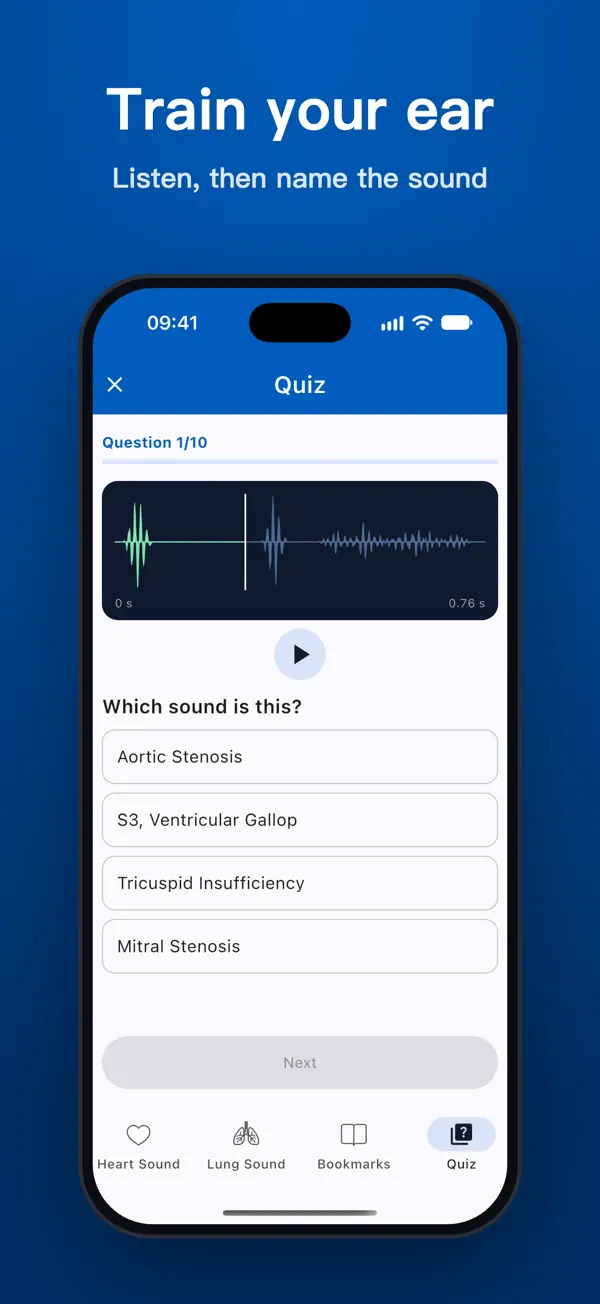
Lung Heart Sounds is an auscultation trainer with 23 heart sounds and 9 lung sounds. You can listen to the sounds discussed in this article side by side until the differences become clear.
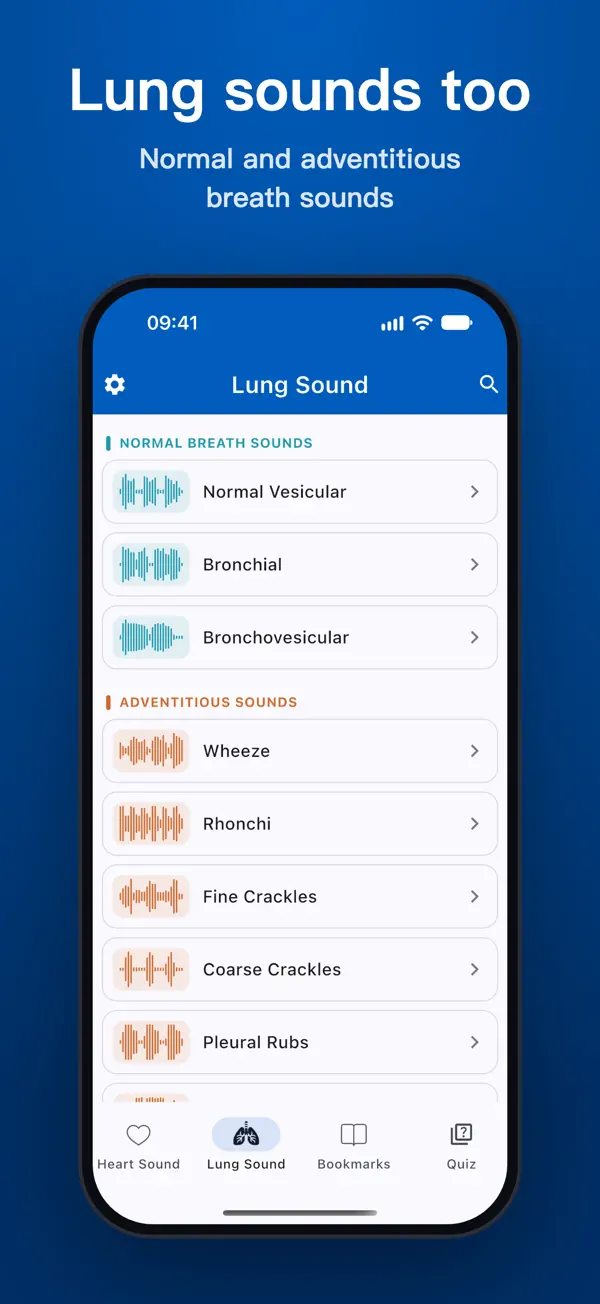
- 9 lung sounds: normal vesicular, bronchovesicular and bronchial breath sounds, plus fine crackles, coarse crackles, wheeze, rhonchi, stridor and pleural rub.
- See what you hear: a live waveform and a spectrogram view, and half-speed (0.5×) playback for any sound.
- Repeat and compare: every sound loops as long as you need. Bookmark the sounds you confuse, such as fine and coarse crackles or wheeze and rhonchi, to build your own review list.
- Test yourself: quiz rounds of 10 questions mix heart and lung sounds and use different recordings each time.
- Works offline, with no account and no ads. Headphones are recommended.
Download on iOS: Lung Heart Sounds on the App Store
Download on Android: Lung Heart Sounds on Google Play
Read more: our practical guide to heart and lung auscultation and what research says about getting better at auscultation.
Disclaimer: this article is for educational purposes only and is not a substitute for formal clinical training or professional medical advice. The studies cited did not evaluate Lung Heart Sounds. The app is not a medical device and must not be used to diagnose or treat any condition.
References
- Melbye H, Garcia-Marcos L, Brand P, Everard M, Priftis K, Pasterkamp H. Wheezes, crackles and rhonchi: simplifying description of lung sounds increases the agreement on their classification: a study of 12 physicians’ classification of lung sounds from video recordings. BMJ Open Respir Res. 2016;3(1):e000136. doi:10.1136/bmjresp-2016-000136. https://pmc.ncbi.nlm.nih.gov/articles/PMC4854017/
- Meslier N, Charbonneau G, Racineux JL. Wheezes. Eur Respir J. 1995;8(11):1942–1948. doi:10.1183/09031936.95.08111942. https://doi.org/10.1183/09031936.95.08111942
- Pasterkamp H, Brand PL, Everard M, Garcia-Marcos L, Melbye H, Priftis KN. Towards the standardisation of lung sound nomenclature. Eur Respir J. 2016;47(3):724–732. doi:10.1183/13993003.01132-2015. https://doi.org/10.1183/13993003.01132-2015
- Aviles-Solis JC, Vanbelle S, Halvorsen PA, et al. International perception of lung sounds: a comparison of classification across some European borders. BMJ Open Respir Res. 2017;4(1):e000250. doi:10.1136/bmjresp-2017-000250. https://pmc.ncbi.nlm.nih.gov/articles/PMC5759712/
- Cottin V, Cordier JF. Velcro crackles: the key for early diagnosis of idiopathic pulmonary fibrosis? Eur Respir J. 2012;40(3):519–521. doi:10.1183/09031936.00001612. https://doi.org/10.1183/09031936.00001612
- Sellarés J, Hernández-González F, Lucena CM, et al. Auscultation of Velcro crackles is associated with usual interstitial pneumonia. Medicine (Baltimore). 2016;95(5):e2573. doi:10.1097/MD.0000000000002573. https://pmc.ncbi.nlm.nih.gov/articles/PMC4748881/
- Moran-Mendoza O, Ritchie T, Aldhaheri S. Fine crackles on chest auscultation in the early diagnosis of idiopathic pulmonary fibrosis: a prospective cohort study. BMJ Open Respir Res. 2021;8(1):e000815. doi:10.1136/bmjresp-2020-000815. https://pmc.ncbi.nlm.nih.gov/articles/PMC8264883/
- Piirilä P, Sovijärvi AR, Kaisla T, Rajala HM, Katila T. Crackles in patients with fibrosing alveolitis, bronchiectasis, COPD, and heart failure. Chest. 1991;99(5):1076–1083. doi:10.1378/chest.99.5.1076. PMID 2019160
- Metlay JP, Kapoor WN, Fine MJ. Does this patient have community-acquired pneumonia? Diagnosing pneumonia by history and physical examination. JAMA. 1997;278(17):1440–1445. doi:10.1001/jama.1997.03550170070035. PMID 9356004
- van Vugt SF, Verheij TJ, de Jong PA, et al. Diagnosing pneumonia in patients with acute cough: clinical judgment compared to chest radiography. Eur Respir J. 2013;42(4):1076–1082. doi:10.1183/09031936.00111012. https://doi.org/10.1183/09031936.00111012
- Wang CS, FitzGerald JM, Schulzer M, Mak E, Ayas NT. Does this dyspneic patient in the emergency department have congestive heart failure? JAMA. 2005;294(15):1944–1956. doi:10.1001/jama.294.15.1944. PMID 16234501
- Shim CS, Williams MH Jr. Relationship of wheezing to the severity of obstruction in asthma. Arch Intern Med. 1983;143(5):890–892. doi:10.1001/archinte.1983.00350050044009. PMID 6679232