Hearing a murmur is only the first step. The next questions are harder: which valve is it coming from, how severe is the lesion, and is there a second, quieter murmur hiding in diastole? Clinicians have long used simple bedside tricks to answer them, such as asking the patient to breathe in, squat, stand or squeeze a hand, and grading the loudness of the murmur from 1 to 6. Research shows which of these tricks work, what the grade of a murmur really tells you, and where the examination runs out. Numbers in brackets refer to the references at the end.

Photo: Los Muertos Crew, via Pexels.
Bedside maneuvers: which ones tell systolic murmurs apart?
Lembo and colleagues evaluated 50 patients with documented systolic murmurs and compared all the standard bedside techniques [1]. Each maneuver was judged by whether it made the murmur louder or softer:
| Origin of the murmur | Response to the maneuver | Sensitivity / specificity |
|---|---|---|
| Right-sided chambers of the heart | Louder with inspiration | 100% / 88% |
| Right-sided chambers of the heart | Softer with expiration | 100% / 88% |
| Hypertrophic cardiomyopathy | Louder with the Valsalva maneuver | 65% / 96% |
| Hypertrophic cardiomyopathy | Louder on going from squatting to standing | 95% / 84% |
| Hypertrophic cardiomyopathy | Softer on going from standing to squatting | 95% / 85% |
| Hypertrophic cardiomyopathy | Softer with passive leg elevation | 85% / 91% |
| Hypertrophic cardiomyopathy | Softer with handgrip | 85% / 75% |
| Mitral regurgitation and ventricular septal defect | Louder with handgrip | 68% / 92% |
| Mitral regurgitation and ventricular septal defect | Louder during transient arterial occlusion | 78% / 100% |
- The murmurs of mitral regurgitation and ventricular septal defect responded in parallel to all maneuvers, so the maneuvers separate them from other systolic murmurs but not from each other.
- No single maneuver identified the murmur of aortic stenosis; the diagnosis could be made by exclusion.
The authors concluded that no single maneuver is 100% accurate, but that the origin of a systolic murmur can be determined accurately at the bedside from the response to a combination of maneuvers [1].
Transient arterial occlusion is the least familiar of these. In an earlier study, the same group inflated blood pressure cuffs on both arms to 20 to 40 mm Hg above systolic pressure for 20 seconds, which made the left-sided regurgitant murmurs of aortic regurgitation, mitral regurgitation and ventricular septal defect louder. In 30 patients with such murmurs and 30 patients with other murmurs, a false-positive result was less likely with this maneuver than with handgrip or squatting [2].
A note of caution comes from a review by Rothman and Goldberger, who examined the evidence behind the most commonly used auscultatory aids and concluded that enthusiasm for them must be tempered, because of limits in sensitivity and specificity and weaknesses in the methods of the validation studies [3].
What this means: start with breathing, which costs nothing: a systolic murmur that gets louder as the patient breathes in is very likely right-sided. For the rest, use several maneuvers and look for a consistent pattern rather than trusting one response.
Does a louder murmur mean a worse leak?
Murmur intensity is traditionally graded on a six-point scale. Desjardins and colleagues studied consecutive patients with chronic isolated aortic regurgitation (40 patients) or mitral regurgitation (170 patients) whose regurgitation was measured by quantitative echocardiography. The grade of the murmur was noted by physicians who were unaware of the study [4].
- Murmur intensity correlated with regurgitant volume and regurgitant fraction in aortic regurgitation (r = 0.60 and 0.67) and in mitral regurgitation (r = 0.64 and 0.67). The correlation was weaker (r = 0.47 and 0.45) in mitral regurgitation of ischemic or functional cause.
- Loud murmurs predicted severe regurgitation: grade 3 or more for aortic regurgitation in 71% of patients, and grade 4 or more for mitral regurgitation in 91%.
- Soft murmurs predicted regurgitation that was not severe: grade 1 or less for aortic regurgitation in 100% of patients, and grade 2 or less for mitral regurgitation in 88%.
- The grades in between were not informative: grade 2 for aortic regurgitation and grade 3 for mitral regurgitation were not correlated with the degree of regurgitation.
The authors concluded that murmur intensity correlates well with the degree of chronic organic aortic and mitral regurgitation and can serve as a simple guideline for diagnostic testing [4].
What this means: the grade is worth recording. A very soft or a clearly loud regurgitant murmur says something about severity, while a murmur in the middle of the scale does not, and the rule is less reliable when mitral regurgitation is ischemic or functional.
How consistently do we grade murmurs?
A grade is only useful if different listeners give the same one. Keren and colleagues ran a single-blind controlled trial with 100 medical students, residents and paediatric attending physicians, who graded random samples of 20 recorded murmurs on the six-point scale. Before a second sample, the intervention group was taught a system that uses the heart sounds as an internal reference for the loudness of the murmur [5].
- Overall, grading accuracy improved 5% more in the intervention group than in the control group (95% confidence interval −0.1% to 10.0%).
- The gain was most pronounced among attending physicians (11%) and students (12%), and for grade 2 murmurs (20%).
- Consistency improved more after the teaching for attending physicians and for grade 2 and grade 3 murmurs.
The authors concluded that using the heart sounds as an internal reference quickly improves accuracy and consistency for some providers and specific murmurs [5].
What this means: the overall effect was small and its confidence interval included no difference, so this is not a cure-all. But comparing the murmur with the heart sounds next to it is a simple habit that helped where grading is hardest, in the soft-to-middle grades.
The quiet one: the diastolic murmur of aortic regurgitation
A review in JAMA’s Rational Clinical Examination series pooled 16 studies of the clinical examination for aortic regurgitation. Most assessed cardiologists as examiners [6].
- Cardiologists’ agreement on diastolic murmurs was moderate using audiotapes (κ = 0.51) and good in the clinical setting (simple agreement 94%).
- Hearing an early diastolic murmur was the most useful finding for ruling in aortic regurgitation: positive likelihood ratio 8.8–32.0 for mild or greater regurgitation and 4.0–8.3 for moderate or greater regurgitation.
- Not hearing one was the most useful finding for ruling it out: negative likelihood ratio 0.2–0.3 for mild or greater regurgitation and 0.1 for moderate or greater regurgitation.
- Apart from the response to transient arterial occlusion (positive likelihood ratio 8.4, negative likelihood ratio 0.3), most other signs had poor sensitivity and specificity.
The authors concluded that the clinical examination by cardiologists is accurate for detecting aortic regurgitation, but that not enough is known about the examination of less expert clinicians [6].
How far does the examination go? Murmurs of unknown cause
Attenhofer Jost and colleagues studied 100 consecutive adults referred for a systolic murmur of unknown cause. Cardiologists examined each patient without the clinical history, electrocardiogram or chest radiograph, and their diagnosis was compared with echocardiography [7]. Echocardiography was normal (a functional murmur) in 21 patients and showed aortic stenosis in 29 and mitral regurgitation in 30, among other findings; 28 patients also had aortic regurgitation.
- The sensitivity of the examination was 100% for ventricular septal defect (4 of 4), 71% for aortic stenosis (21 of 29) and 67% for a functional murmur (14 of 21).
- It was only 21% for associated aortic regurgitation (6 of 28) and 18% for intraventricular pressure gradients (2 of 11).
- In 28 (35%) of the 79 patients with organic heart disease, more than one abnormality was found, most often combined aortic and mitral valve disease.
- Significant heart disease was missed completely in only 2 patients.
The authors concluded that a functional murmur can usually be distinguished from an organic one, but that the ability of the examination to assess the exact cause is limited, especially when more than one lesion is present [7].
What this means: the two studies fit together. An early diastolic murmur is a strong sign when it is heard [6], but next to a systolic murmur it is easily overlooked [7]. The second lesion is the one that gets missed.
Lessons for telling murmurs apart
- Listen through a few breaths. A systolic murmur that grows with inspiration and fades with expiration points to the right side of the heart [1].
- Use maneuvers in combination. None is 100% accurate alone, and the evidence behind them has limits [1][3]. Aortic stenosis has no maneuver of its own [1].
- Grade every murmur against the heart sounds. Using the heart sounds as a reference made grading more accurate where it is hardest [5].
- Read the extremes of the scale. Very soft and clearly loud regurgitant murmurs carry information about severity; middle grades do not [4].
- After a systolic murmur, go back and listen to diastole. An early diastolic murmur is the key finding for aortic regurgitation [6], and it is the one most often missed when another murmur is present [7].
- Expect more than one lesion. In about a third of patients with organic disease there was a second abnormality [7].
Practice with Lung Heart Sounds
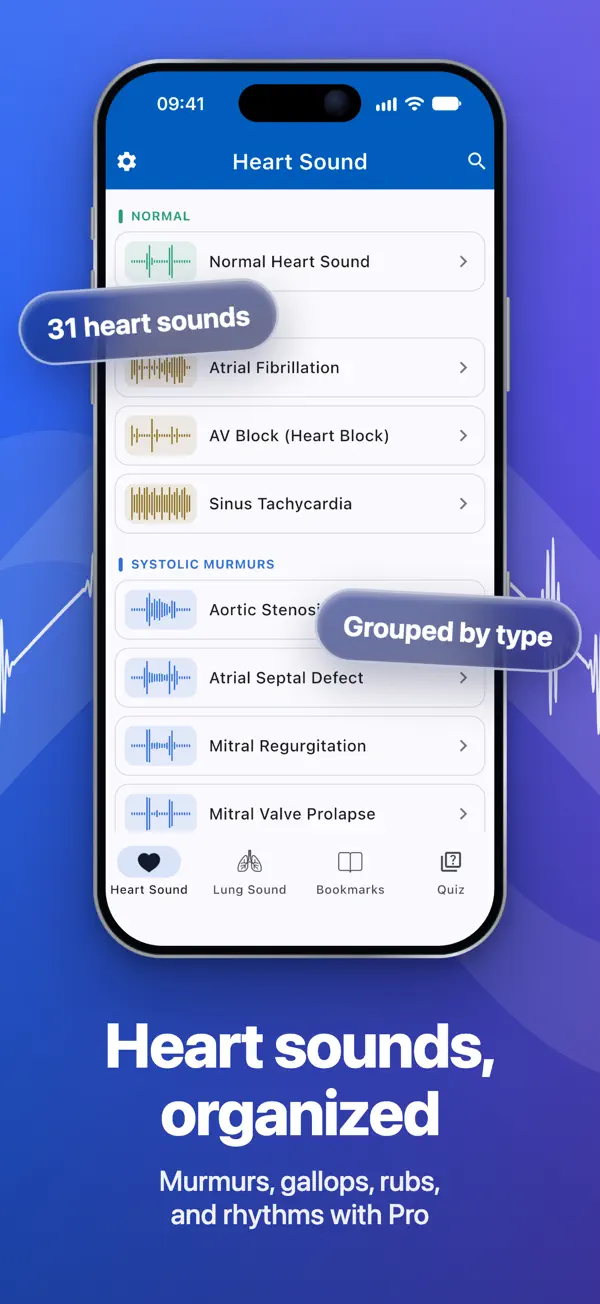
Lung Heart Sounds is an auscultation trainer with 31 heart sounds and 16 lung sounds. It lets you hear the same murmur at different loudness, and compare systolic and diastolic murmurs back to back.
- Murmur grades and heart rates: reference heart sounds also come at other heart rates and murmur grades (Levine scale), so you learn the sound itself, not just one recording. These versions are free.
- Valve murmurs: aortic stenosis, aortic insufficiency, mitral stenosis, mitral regurgitation, mitral valve prolapse, pulmonic stenosis, pulmonic insufficiency, tricuspid insufficiency and the Austin Flint murmur, plus atrial septal defect, ventricular septal defect and patent ductus arteriosus.
- Murmurs by timing (Pro): early systolic, mid-systolic (ejection), late systolic, holosystolic and late diastolic (presystolic).
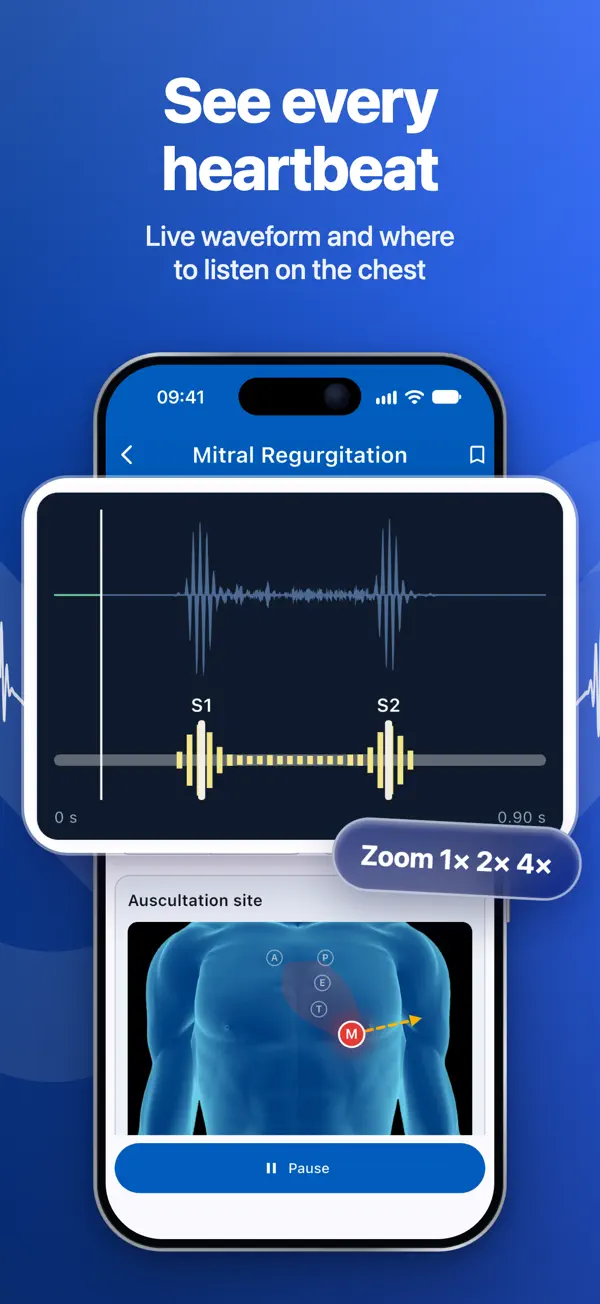
- Know where to listen: a chest diagram highlights the aortic, pulmonic, Erb’s point, tricuspid and mitral areas, loudest area first, with arrows showing where each murmur radiates and practical tips on diaphragm or bell, patient position and how the sound changes with breathing.
- See what you hear: a live phonocardiogram with S1 and S2 marked; with Pro, a spectrogram view and half-speed (0.5×) playback to pick out splits, clicks and soft murmurs.
- Test yourself: 10 questions per round, 4 options each, with different recordings each time. 2 free rounds every day; unlimited rounds with Pro.
- Free to download and works offline, with no account and no ads. Pro is a one-time purchase, not a subscription. Headphones are recommended.
Download on iOS: Lung Heart Sounds on the App Store
Download on Android: Lung Heart Sounds on Google Play
Read more: what research says about heart murmurs and gallops (aortic stenosis, screening, murmurs in children) and our practical guide to heart and lung auscultation (listening areas and common murmurs).
Disclaimer: this article is for educational purposes only and is not a substitute for formal clinical training or professional medical advice. The studies cited did not evaluate Lung Heart Sounds. The app is not a medical device and must not be used to diagnose or treat any condition.
References
- Lembo NJ, Dell’Italia LJ, Crawford MH, O’Rourke RA. Bedside diagnosis of systolic murmurs. N Engl J Med. 1988;318(24):1572–1578. doi:10.1056/NEJM198806163182404. PMID 2897627
- Lembo NJ, Dell’Italia LJ, Crawford MH, O’Rourke RA. Diagnosis of left-sided regurgitant murmurs by transient arterial occlusion: a new maneuver using blood pressure cuffs. Ann Intern Med. 1986;105(3):368–370. doi:10.7326/0003-4819-105-3-368. PMID 2874761
- Rothman A, Goldberger AL. Aids to cardiac auscultation. Ann Intern Med. 1983;99(3):346–353. doi:10.7326/0003-4819-99-3-346. PMID 6137174
- Desjardins VA, Enriquez-Sarano M, Tajik AJ, Bailey KR, Seward JB. Intensity of murmurs correlates with severity of valvular regurgitation. Am J Med. 1996;100(2):149–156. doi:10.1016/s0002-9343(97)89452-1. PMID 8629648
- Keren R, Tereschuk M, Luan X. Evaluation of a novel method for grading heart murmur intensity. Arch Pediatr Adolesc Med. 2005;159(4):329–334. doi:10.1001/archpedi.159.4.329. PMID 15809384
- Choudhry NK, Etchells EE. The rational clinical examination. Does this patient have aortic regurgitation? JAMA. 1999;281(23):2231–2238. doi:10.1001/jama.281.23.2231. PMID 10376577
- Attenhofer Jost CH, Turina J, Mayer K, Seifert B, Amann FW, Buechi M, et al. Echocardiography in the evaluation of systolic murmurs of unknown cause. Am J Med. 2000;108(8):614–620. doi:10.1016/s0002-9343(00)00361-2. PMID 10856408